The Complete Lionel Hampton Victor Sessions 1937-1941
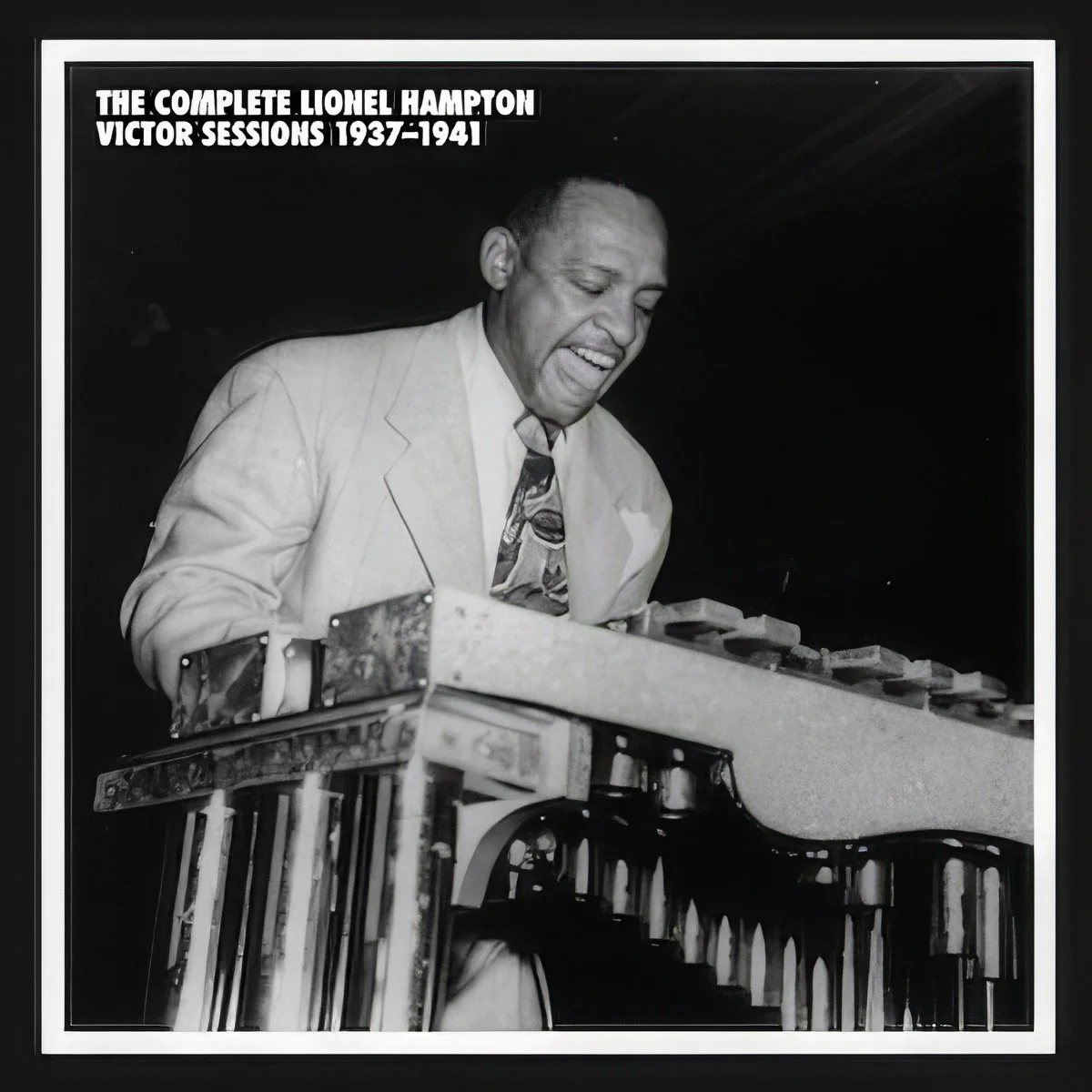
Lionel Leo Hampton lived to the ripe, Nestorian age of 94, and kept his big band together longer than any of his contemporaries. After fits and starts as a bandleader, Hampton formed a big band upon leaving Benny Goodman in 1940, and it worked consistently in varying configurations for over sixty years. He created a musical universe that was all his own, and it ranged from (to use H.L. Mencken’s notable phrase) a carnival of bumcombe to simply exquisite. The common denominator was Hampton’s unquenchable desire to engage his audience and he was willing to take any step necessary to that end. This included having a band member jump off a bridge into the water, and on one notable occasion, continuing to play after the promoter of a seaside venue told the band to cease and used the rotating stage to turn the band towards the water, with no electricity. Hampton frankly behaved like a man possessed (though big band chronicler George T. Simon once wondered by precisely what) and there can be no doubt that he demanded at least as much of himself as he demanded from his musicians. It may have been the extremity of his desire to please his public that led to what could benevolently be called his moral myopia when it came to relations with his employees. This is not unrelated to the music herein.
Unburdened by the aesthetic and in many cases, the moral considerations that concerned his peers (encouraged greatly by his wife Gladys, who was not for a moment bound by any of the gender- or race-based limitations placed on her by the music business) Hampton paid the lowest wages imaginable, and churned out a product that was immediately identifiable and attractive to the lowest common denominator of popular taste. That as much good music came out of his bands is it did was due to his indefatigable energy, musical abilities and a desire to please his audience. It certainly did not arise from a desire on his part to encourage the individuality of his sidemen; rather, he used them in the most utilitarian mode imaginable. As one of his ex-sidemen trombonist/composer/arranger Slide Hampton (no relation) told interviewer Bob Bernotas:
“After Buddy Johnson I had the misfortune of going with Lionel Hampton. I was much better off with Buddy, because Buddy was the exact opposite to Lionel Hampton… (who) is also a great musician, but really not a very caring person. He never really tried to give the musicians the kind of conditions that they could work in and would inspire them. And he never really inspired people to go to other heights. If you were with his band and he really liked you, he would almost threaten you if you wanted to leave and go with somebody else.
And that was very unfortunate because he was a guy that had possibilities, especially for a lot of the Afro-American musicians, to open up doors for them. But he was such an egomaniac he couldn't consider what was happening for anybody else.
He had a lot of good musicians in the band. Clifford Brown was there, Wes Montgomery was there, Art Farmer, Gigi Gryce, Benny Golson. And had some good bands. Sometimes the band was fantastic, but he still had to be the one that was noticed the most. He had to be out front, which was good. The guys were for that, too, but he never was able to say, "This band is really something that's important in my musical life." He could never do that.”
It is the intimate musical contact with his peers and his willingness, on occasion, to let them take the musical reins on these sessions that makes this series so remarkable and so revealing of the best Hampton had to offer.
Born in Birmingham, Alabama on April 20, 1908, Hampton’s family relocated to Louisville, Kentucky, and the young Lionel was eventually sent to Chicago to be raised by his grandmother. He was surrounded by many of jazz’s founding fathers. In and around the city at that time were King Oliver, Louis Armstrong, Jelly Roll Morton, Johnny and Baby Dodds and Zutty Singleton. There were also youngsters like him who were immersed in the music, including Dave Tough, Milt Hinton, Benny Goodman, and Sid Catlett. The negative effects of city life persuaded his grandmother to send Lionel to a Catholic school in nearby Kenosha, Wisconsin (66 miles away) , where one Sister Petra of the Holy Rosary Academy taught him the drum rudiments that in one form or another became the foundation of his musical conception.
The formation of a newsboy’s band formed by the Chicago Defender gave the young Hampton the opportunity to expand his percussion skills as he graduated from the bass drum to the snare, the tympani and eventually the marimba. A major influence was percussionist Jimmy Bertrand, who was featured for a decade in Erskine Tate’s Vendome Orchestra, which was one of Chicago’s most famous African-American units. Bertrand tutored not only Hampton, but also Catlett and many other budding drummers. Playing an instrument with notes led to an early knowledge of harmony, which put him in good stead as he began to memorize and perform solos by his favorite players (most notably Earl Hines and Armstrong) on his mallet instruments. Leaving home while still in his mid-teens to join a band, Hampton eventually ran into saxophonist Les Hite, who when he formed his own band, asked the young drummer to move to Los Angeles. Conveniently, Hampton was a relative who worked at a film studio, so he had a home base as he established himself, and pretty soon found a featured spot (on the drums and the piano, as well as singing) with Paul Howard’s Quality Serenaders, an outstanding band which remains relatively obscure to most jazz historians, notwithstanding the footnote given them in Gunther Schuller’s The Swing Era. It was a first-rate unit, easily on the same level as the best East Coast bands. In the music notes that follow, Louis Armstrong paints a wonderful picture of the young LA-based Hampton, whose combination of vivaciousness and swing was irresistible. It was those qualities which landed him a steady job as the drummer at Frank Sebastian’s Cotton Club, where he played in several bands. When Armstrong himself appeared there (backed by Hite’s band), he was smitten, as noted, with Hampton, an association that was documented extensively on a series of classic recordings where Hampton not only swung the band with great taste (SHINE) but also engaged in some opening patter with Armstrong (YOU’RE DRIVING ME CRAZY) as well as playing the vibraphone 9MEMORIES OF YOU0. Much has been made of the last event, but someone in Luis Russell’s band (possibly drummer Paul Barbarin) had already played a vibraphone-like instrument on Armstrong’s SONG OF THE ISLANDS. Indeed, it was Hampton’s playing of Armstrong’s solo from that recording that eventually led the trumpeter to ask Hampton to noodle behind him, which led to MEMORIES OF YOU. Many musicians at the time doubled on the vibes, including Jack Teagarden, who can be seen playing them in a 1929 Ben Pollack short.
After the Armstrong gig ended, Hampton spent the next several years playing with Les Hite, while remaining the house drummer at the Cotton Club, as well playing in Charlie Echols’s band. He eventually formed his own big band, which included Herschel Evans, Johnny Miller, Bumps Meyer and Tyree Glenn. In 1936 he was reunited with Armstrong, playing the vibes during a Hawaiian-inspired session for Decca Records as well as an on-screen appearance in Pennies From Heaven, where Hampton backs Louis on SKELETON IN THE CLOSET, even coming out from behind the drums to do some tapping. Indeed, as a member of Les Hite’s band, Hampton had already appeared in several films, including Ex-Flame (1930), The Sport Parade (1932), Taxi (1932), Cabin In the Cotton (1933), Fast Workers (1933) and Sing Sinner Sing (1933). He also studied music at the University of Southern California.
During the summer of 1936, the Goodman band was in Hollywood making their first screen appearance in The Big Broadcast of 1937 when Benny Goodman heard and jammed with Hampton at the Paradise Café. While it may not have been as cartoonish an affair as was immortalized in The Benny Goodman Story (Benny once told me that Rock Hudson should have gotten his role instead of Steve Allen), Hampton was indeed functioning as the major domo at this rather seedy joint. Goodman was so impressed by Hampton that he brought Teddy Wilson and Lionel Hampton down to jam the following night, and just hours later the Goodman Trio became a quartet by recording a bona-fide masterpiece, MOONGLOW. Their synergy brought out the very best in Hampton. Indeed, the best recordings Hampton was to make over the course of his long career were always as a sideman or when functioning under someone else’s musical direction.
Goodman sent for Hampton to come to New York and join the Quartet full time in November 1936. His extroverted personality made for a perfect fit, matching at times Krupa’s maniacal zeal and offering a marked and welcome contrast to Goodman and Wilson’s relative soberness. Wilson was already a year and a half into his classic small group series for Brunswick Records (with a sister series led by Billie Holiday for Vocalion) when Hampton was approached to create the recordings that comprise this collection.
